
- This event has passed.
Dok Night – SYMBIOPSYCHOTAXICINEMA Presented by Jeffrey Babcock
Every Thursday there’s a Vegan Dinner accompanying an exhibition opening/closing, a live performance, live music, movie screening or … Come meet other people interested in art and activism, good food and great prices. Bring your favourite game and your friends. Or meet new people at the bar.
18:00 Bar open
19:00 Vegan Ethiopian Dinner by Moknen
20:30
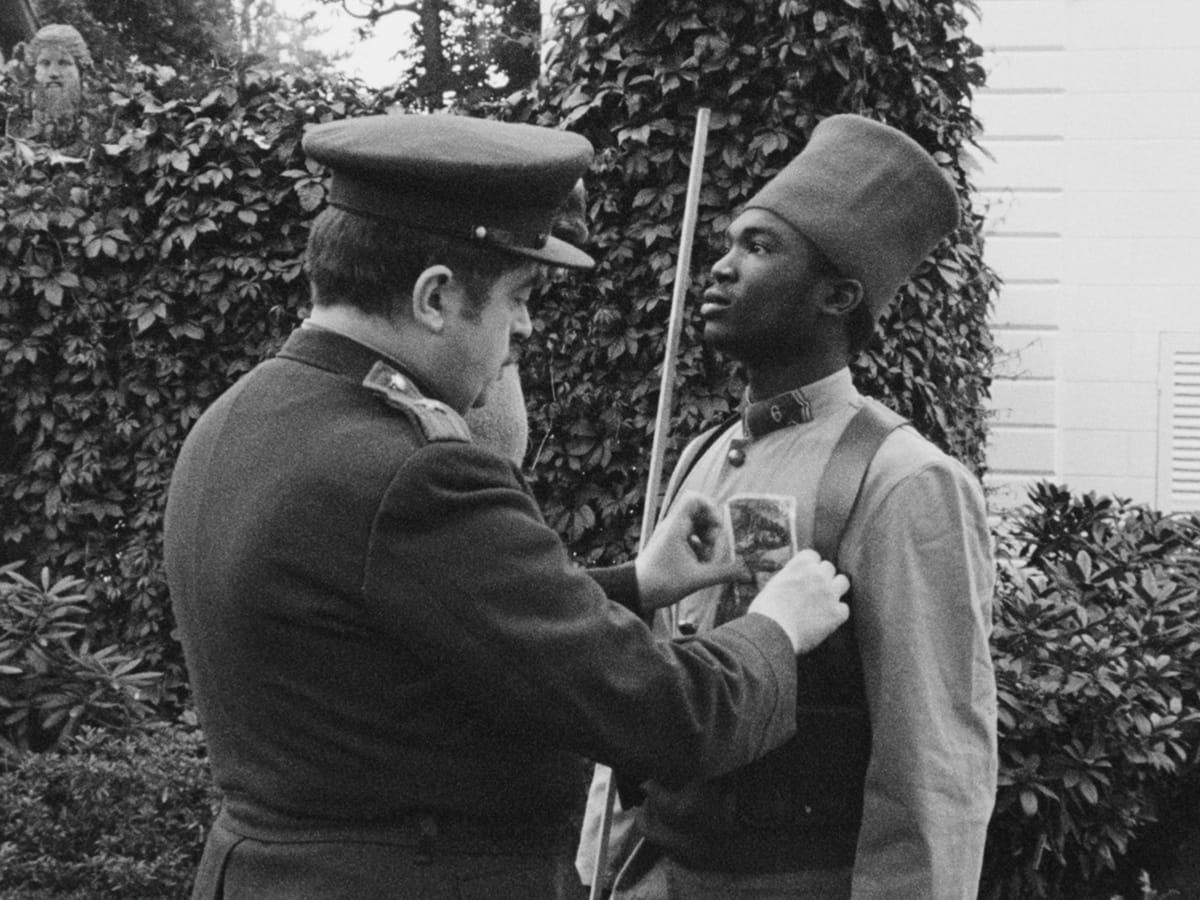
SOLEIL Ô 1967
(Oh, Sun)
Directed by Med Hondo
104 minutes
In French and Arabic, with English subtitles
Of course colonialism and racism are not jokes, but that makes it even more surprising when a director from Africa can make a comic farce making fun of the situation. But that goes to show that if we take any issue so deadly seriously, then we have already lost the battle because we’ve given up our imagination and creativity. Born in Aïn-Béni-Mathar, Morocco and raised in Mauritania, Med Hondo was one of the first directors from the African continent – along with Ousmane Sembène from Senegal – to make movies that hit back against colonialism in general, and specifically France.
When a young man from Mauritania iImmigrates to Paris, at first he is overjoyed, Paris was always a dream city that he looked up to as the epitome of culture and glamour. The minute he arrives though, he is faced with the difficulty of finding a way to survive. Everything across-the-board is against him, from the Catholic Church to pedestrians on the street, to the economic situation and political system. Racism is everywhere, even with the simplest of things. Some of the humor of this flick comes from just watching the hypocrisy of this so-called civilised liberal Parisian society. Some of the scenes in the streets even seem as if they were shot in a documentary guerrilla filmmaking way – staging a situation on a street corner and then just letting the camera roll, catching people’s reactions. But there is indeed a story, which unfolds in a freewheeling fashion – sometimes with a delirious joie de vivre… Including the soundtrack, which is so playfully experimental and irreverent at times that it becomes hilarious. This is not a cinema that is designed to suck you into an illusionary reality, instead here cinema is treated like raw material… which is an approach that’s much more honest and free. The playfulness of Hondo’s filmmaking has such a feeling of liberation and freshness.
The film shows that real emancipation is not only economic, but the fundamental crux is actually psychic… and that’s what needs to be released. How to get rid of an entire era of subjugation, injustice, humiliation and degradation? How can one move on without recognition of that history? The absurdity of our main character’s situation becomes almost hysterical, and the film builds up to an unnerving climax which is almost a battle cry. The director claims that the movie is semi-autobiographical.
Director Med Hondo was acting in theatres while he lived in Paris, scraping together his extra pennies each month to buy the film stock to shoot this movie. That’s why it took him three years to make it, shooting only on the weekends when his friends were free to help along. The technical crew consisted of only five people, all volunteers. That’s what we need today, not just an easier lifestyle and more convenience…. but also a spirit of passion and determination. Music is an important element and it weaves through the film, from drum percussion to singing live in cafés with an acoustic guitar. Some of the people that contribute to the music track are the legendary Indian tabla player Jean-Paul Drouet, the modern jazz of Michel Portal, the Congolese group Les Black Echos and Cameroonian musician Georges Anderson.
A series of socially engaged movies, screened once a month on Thursdays. Touching on such hot topics as immigration, homelessness, racism, education, radical gender propositions, the pandemic and gentrification, these films not only explore visionary politics, but are also chosen to stir our imagination and creativity. The essence of cinema is the collective experience, and these screenings are aimed at creating intimate communities again in an increasingly hectic and fragmented world.
